
Customs
Customs
The customs clearance process involves two key stages: Export from China Customs and Import into the U.S. for customs clearance.
AMS (Ocean AMS)
The Automated Manifest System (AMS) is an electronic system mandated by U.S. Customs, requiring carriers to submit manifest data for goods prior to entry. AMS facilitates:
Advance submission of cargo information by carriers.
Customs review and shipment release.
AMS is mandatory for both air and sea shipments. This section focuses on Ocean AMS, where the carrier is responsible for declaring customs information.
Create Ocean AMS
1. Navigate to Customs > AMS > Ocean AMS. 2. Click + Add to open the Create Ocean AMS page. 3. Enter the following seven parts of information:
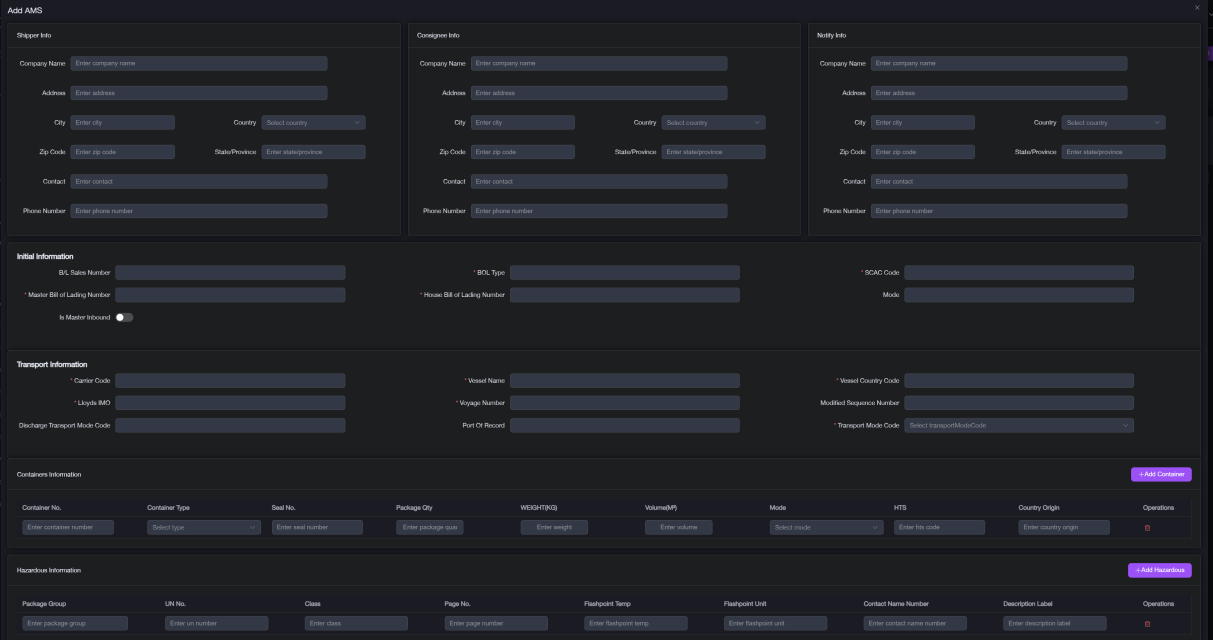
Initial Info
Field Name | Description |
|---|---|
BL Status Indicator | Specifies the current status of the Bill of Lading (e.g., Original, Copy). |
BL Type | Defines the type of Bill of Lading (e.g., Master, House). |
SCAC Code | A unique identifier for the carrier, issued by the NMFTA (e.g., Maersk). |
Master Bill of Lading Number | The number for the master Bill of Lading, issued directly by the carrier to the shipper or agent. |
House Bill of Lading Number | The number for the house Bill of Lading, issued by the freight forwarder to the shipper. |
Batch Number | A unique identifier for a batch of goods used for tracking and organizing related data. |
Value | (Optional) Total shipment value. |
Is Master Inbound (Toggle) | Indicates whether the Master Bill of Lading is for inbound shipments (Yes/No). |
Transport Info
Field Name | Description |
|---|---|
Carrier Code | Code identifying the carrier (must be AMS-registered). |
Vessel Name | Name of the vessel transporting the goods (e.g., MSC Zoe). |
Vessel Country Code | The country where the vessel is registered (e.g., US). |
Lloyds IMO | The 7-digit IMO (International Maritime Organization) number for the vessel. |
Voyage Number | Identifier for the vessel’s specific voyage. |
Manifest Sequence Number | Sequential number for identifying shipments within the manifest. |
Pre-carriage Transport Mode Code | Code representing the transport mode before the main carriage (e.g., Truck, Rail). |
Place of Receipt | Location where the carrier received the goods. |
Transport Mode Code | Main transport mode for the shipment (e.g., Sea, Air, Land). |
Port Info
Field Name | Description |
|---|---|
Port of Loading Code | The code for the port where goods are loaded onto the vessel. |
First Foreign Port Code | The first foreign port visited after departure. |
Last Foreign Port Code | The last foreign port visited before arrival at the destination country. |
Port of Unloading Code | The code for the port where goods are unloaded in the destination country. |
US Destination Port | The final destination port within the U.S. |
Foreign Destination Port | The final destination port outside the U.S. |
Measurements Info
Field Name | Description |
|---|---|
Weight | The weight of the goods. |
Weight Unit | The unit for weight measurement (e.g., KG, LB). |
Volume | The volume of the goods. |
Volume Unit | The unit for volume measurement (e.g., CBM, CFT). |
Miscellaneous Info
Field Name | Description |
|---|---|
Estimated Arrival Date | Expected date and time of arrival. |
Manifest Quantity | Total quantity of items listed in the manifest. |
Manifest Unit Code | Unit of measure for the manifest quantity (e.g., Pieces, Cases, KG). |
Payment Method | Payment method for the shipment (e.g., Prepaid, Collect). |
Inbound Carrier Code | Code identifying the carrier for inbound shipments. |
Inbound Entry Type | Type of inbound entry (e.g., Formal Import, Temporary Import). |
Second Notify Party 1/2 | Contact or organization notified when goods arrive or clear customs. |
Is BTA FDA? (Toggle) | Indicates compliance with U.S. Bioterrorism Act (BTA) and FDA regulations. |
Container Info
Field Name | Description |
|---|---|
Container No. | The unique identifier for the container. |
Container Type | Type of container (e.g., 20FT, Reefer, Tank). |
Seal No. | The seal number of the container for security purposes. |
Package Quantity | Number of packages within the container. |
Weight | Weight of the goods in the container. |
Volume | Volume of the goods in the container. |
Mode | Indicates whether the container is FCL (Full Container Load) or LCL (Less than Container Load). |
HTS Code | Harmonized Tariff Schedule code for the goods. |
Country of Origin | The country where the goods were manufactured or produced. |
Hazardous Info
Field Name | Description |
|---|---|
Package Group | Packaging group classification for hazardous materials. |
UN No. | The UN identification number for hazardous goods. |
Class | Classification code for dangerous goods (e.g., Explosives, Flammables). |
Flashpoint Temp | The minimum temperature at which flammable vapor ignites. |
Contact Name/Number | Emergency contact for handling hazardous materials. |